NSFAS Online Application 2027-2028: Complete Guide to Apply for the 2027 Academic Year
NSFAS Application 2027-2028
Paying for higher education can be one of the biggest challenges facing South African students and their families. Fortunately, the National Student Financial Aid Scheme (NSFAS) continues to provide financial assistance to qualifying students who wish to study at public universities and Technical and Vocational Education and Training (TVET) colleges.
If you plan to begin your studies during the 2027 academic year, understanding the NSFAS Online Application 2027 process is one of the most important steps you can take. Applying correctly—and on time—can improve your chances of receiving funding that helps cover tuition, accommodation, learning materials, and other approved study-related expenses.
Everything you need to know about the NSFAS Online Application 2027. It is based on publicly available information from the official NSFAS website and current funding policies. Where official information for the 2027 application cycle has not yet been released, this guide clearly indicates that applicants should wait for official announcements rather than relying on speculation.
Whether you are a Grade 12 learner, a first-time university applicant, a TVET college student, or a returning student, this guide will help you prepare for a successful NSFAS application.
What is NSFAS?
The National Student Financial Aid Scheme (NSFAS) is a South African government entity established to provide financial assistance to eligible students from low-income and working-class households.
Operating under the Department of Higher Education and Training (DHET), NSFAS aims to make higher education more accessible by helping qualifying students pay for their studies at public universities and TVET colleges.
Over the years, NSFAS has supported hundreds of thousands of students across South Africa, enabling many to earn qualifications that improve their employment prospects and contribute to the country’s social and economic development.
Funding is awarded according to the eligibility criteria and funding policies published by NSFAS. Applicants are encouraged to consult the official NSFAS website for the latest updates, policies, and announcements.
Understanding the NSFAS Online Application 2027
The NSFAS Online Application is the official online process through which eligible students apply for financial aid for the 2027 academic year.
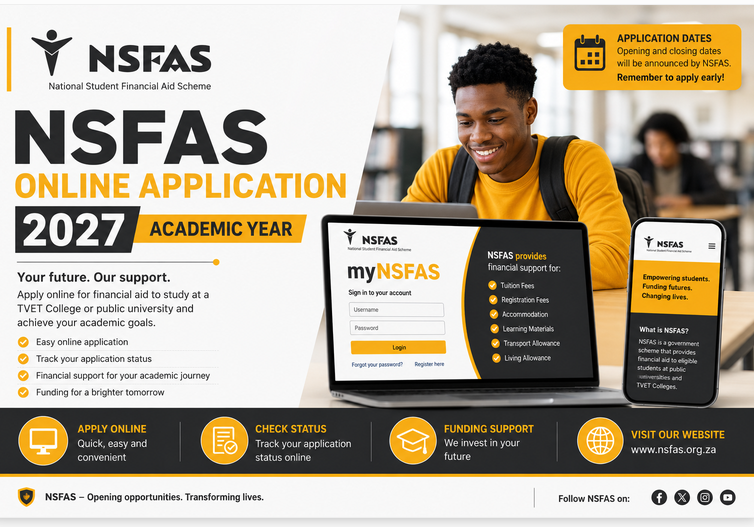
Applications are submitted electronically through the myNSFAS portal, which allows applicants to:
- Register a myNSFAS account.
- Complete an online application.
- Upload supporting documents.
- Track the progress of an application.
- Receive important notifications from NSFAS.
Using the online portal makes the application process more convenient and allows applicants to manage their funding information in one secure place.
READ ALSO: Log in to nsfas wallet
Has NSFAS Opened Applications for 2027?
At the time of writing, NSFAS has not yet officially announced the application dates for the 2027 academic year.
This means prospective applicants should not rely on unofficial websites or social media posts claiming to know the opening or closing dates.
Instead, students should regularly monitor:
- The official NSFAS website
- Their myNSFAS account
- Official NSFAS social media channels
Once the application window is announced, students should begin the online application process as early as possible. Applying early allows more time to gather documents, correct mistakes, and respond to any requests for additional information.
Why NSFAS Funding Matters
For many South African families, the cost of higher education can make university or TVET college seem out of reach. Tuition fees, accommodation, textbooks, transport, and daily living expenses can quickly become overwhelming.
NSFAS helps reduce these financial barriers by providing funding to eligible students, allowing them to focus on their education rather than worrying about how to pay for it.
The benefits of NSFAS extend beyond individual students. By improving access to higher education, the scheme contributes to developing skilled professionals, supporting economic growth, and creating opportunities for future generations.
Who Can Apply for NSFAS?
Although the official 2027 application guidelines have not yet been released, applicants are generally expected to meet the eligibility criteria published by NSFAS.
You may qualify if you:
- Are a South African citizen.
- Intend to study at a public university or public TVET college.
- Meet the applicable household income threshold.
- Are applying for an approved qualification.
- Meet the academic progression requirements if you are a returning student.
Eligibility is assessed according to the NSFAS funding policy applicable during the application cycle.
Meeting the basic requirements does not automatically guarantee funding. Every application is assessed individually.
Who Does Not Qualify?
While many students are eligible for financial assistance, some applicants may not qualify.
Examples include applicants who:
- Do not meet the citizenship requirements.
- Do not satisfy the household income criteria.
- Enrol at institutions or programmes that are not covered by NSFAS funding.
- Fail to meet the academic progression requirements for continuing funding, where applicable.
- Submit incomplete or inaccurate applications.
Applicants should carefully read all eligibility requirements before submitting their applications to avoid disappointment.
Household Income Requirements
Household income is one of the key factors considered during the NSFAS application process.
NSFAS uses income thresholds to determine financial need. These thresholds are reviewed and published by NSFAS as part of its funding policy.
Because income requirements may change over time, applicants for the 2027 academic year should consult the latest official NSFAS funding guidelines once they are published.
Where required, applicants may need to provide supporting information or documentation relating to household income during the assessment process.
Preparing Before Applications Open
One of the biggest mistakes students make is waiting until the application period opens before preparing their documents.
Instead, you should begin preparing now by:
- Ensuring your South African ID document is valid.
- Confirming your contact details are up to date.
- Creating or updating your email address.
- Keeping your cellphone number active.
- Organising any supporting documents you may need.
- Applying for admission to your preferred public university or TVET college.
Preparing early helps reduce stress and allows you to submit a complete application once the official NSFAS application window opens.
What Happens After You Qualify?
If your application is approved, NSFAS will communicate the outcome through your myNSFAS account and other official communication channels.
Approved students may receive funding according to the applicable NSFAS funding policy. Depending on the approved package and institutional arrangements, funding may include tuition fees and other approved study-related support.
Students are expected to comply with all NSFAS funding conditions and maintain satisfactory academic progress throughout their studies.
NSFAS Funding, Required Documents and Step-by-Step Online Application Guide
What Does NSFAS Funding Cover?
One of the biggest advantages of receiving NSFAS funding is that it can significantly reduce the financial burden of studying at a public university or TVET college.
Funding is awarded in accordance with the NSFAS funding policy applicable to the academic year and the type of institution where you are enrolled.
Depending on your eligibility and approved funding package, NSFAS may provide support for:
Tuition Fees
Tuition is one of the largest expenses for students pursuing higher education. NSFAS funding can cover approved tuition costs charged by participating public universities and TVET colleges.
Registration Fees
Eligible students may receive assistance with registration costs required by their institution before commencing their studies.
Student Accommodation
Students who qualify for accommodation support may receive funding for approved residences or accredited private accommodation, subject to NSFAS policies and institutional arrangements.
Learning Materials
Studying requires textbooks, stationery, digital resources, and other educational materials. NSFAS provides allowances for approved learning materials in accordance with its funding rules.
Transport Allowance
Students who commute to campus may qualify for transport assistance where this benefit is included under the applicable funding policy.
Living Allowance
Depending on institutional arrangements and the approved funding package, eligible students may receive a living allowance to assist with day-to-day study-related expenses.
Because funding policies are reviewed periodically, students applying for the 2027 academic year should always consult the latest NSFAS funding guidelines after they are officially published.
Documents Required for the NSFAS Online Application 2027
Preparing your documents before the application window opens can make the online application process much easier.
According to the official NSFAS guidance, the exact list of documents depends on your individual circumstances. After you begin your application, the myNSFAS system will generate the documents required for your application type.
Documents that may be required include:
- South African ID document or birth certificate.
- Parent, guardian or spouse ID documents (where applicable).
- Proof of household income (where applicable).
- Consent Form.
- Declaration Form (where applicable).
- Disability Annexure Form for applicants living with disabilities.
- Vulnerable Child Declaration Form where applicable.
- Supporting legal documents such as proof of guardianship, death certificates, divorce decrees or marriage certificates, depending on the applicant’s circumstances.
Important Things To Note:
Before uploading your documents:
- Ensure all copies are clear and readable.
- Check that every required page has been uploaded.
- Use the correct document for each upload category.
- Keep electronic copies on your computer or mobile phone.
- Never upload altered or fraudulent documents.
Incomplete documentation is one of the most common reasons applications take longer to process.
How to Create a myNSFAS Account
Your myNSFAS account is your personal online profile used to apply for funding, upload documents, receive notifications, and monitor your application.
Creating an account is free.
Step 1: Visit the myNSFAS Portal
Go to the official myNSFAS portal and select the option to register for a new account.
Step 2: Enter Your ID Number
Your South African ID number serves as your username.
Enter your details exactly as they appear on your official identification documents.
Step 3: Provide Your Contact Details
You will need:
- Your own email address.
- Your own cellphone number.
Do not use another person’s contact details, as important notifications and verification messages will be sent directly to you.
Step 4: Create a Secure Password
Choose a strong password that combines:
- Uppercase letters
- Lowercase letters
- Numbers
- Special characters
Do not share your password with anyone. NSFAS warns applicants never to disclose their login credentials.
Step 5: Verify Your Account
Follow the verification instructions sent to your registered email address or cellphone number.
Once verification is complete, you can log in and begin your application.
Step-by-Step NSFAS Online Application Process
The online application has been designed to be straightforward and user-friendly.
Step 1: Log into Your myNSFAS Account
Access your account using your South African ID number and password.
Step 2: Start a New Application
Select the option to begin your NSFAS application for the applicable funding cycle once applications officially open.
Step 3: Complete Your Personal Information
Provide accurate information, including:
- Full names
- Date of birth
- Contact details
- Residential address
Always ensure your information matches your official documents.
Step 4: Provide Household Information
Complete all financial and household information requested during the application.
This information helps NSFAS determine your eligibility for financial assistance.
Step 5: Provide Academic Information
Enter details relating to:
- Your institution
- Your intended qualification
- Your current education status
Review every entry carefully before proceeding.
Step 6: Upload Supporting Documents
Upload all requested documents generated by the application system.
Before submitting, check that every document:
- Is readable.
- Has been uploaded correctly.
- Matches the requested category.
- Is complete.
Step 7: Review Your Application
Carefully review every section.
Pay special attention to:
- ID numbers
- Contact details
- Household information
- Uploaded documents
Correct any errors before continuing.
Step 8: Submit Your Application
After reviewing your information, submit your application.
Once submitted, save your confirmation details or reference number for future use.
Uploading Supporting Documents Successfully
Many applicants experience delays because documents were uploaded incorrectly.
Follow these best practices:
- Scan documents clearly.
- Avoid blurred photographs.
- Upload every requested document.
- Do not submit incomplete files.
- Keep copies of everything you upload.
If NSFAS requests additional documents during the assessment process, upload them as soon as possible through your myNSFAS account.
Common Application Mistakes to Avoid
Every year, many students unintentionally delay their applications by making simple mistakes.
Avoid the following:
- Waiting until the final day to apply.
- Using someone else’s email address or cellphone number.
- Uploading unreadable documents.
- Entering incorrect ID numbers.
- Leaving mandatory fields incomplete.
- Forgetting to save confirmation details.
- Sharing your myNSFAS password with anyone.
Taking your time and checking your information carefully can improve your overall application experience.
Expert Advice for First-Time Applicants
If this is your first NSFAS application, consider the following tips:
- Gather all your documents before applications open.
- Read every instruction carefully.
- Complete each section accurately.
- Keep your login details secure.
- Monitor your myNSFAS account regularly for updates.
- Respond promptly if NSFAS requests additional information.
Preparing early and following official guidance can help you avoid unnecessary delays and improve your application experience.
Checking Your NSFAS Application Status, Appeals Process, and Expert Advice
How to Check Your NSFAS Application Status 2027
After successfully submitting your NSFAS Online Application, the next important step is monitoring its progress.
Fortunately, NSFAS allows applicants to track their applications online through the secure myNSFAS portal. Regularly checking your application helps you stay informed and ensures you can respond quickly if additional information or documents are requested.
Steps to Check Your NSFAS Status
- Visit the official myNSFAS portal.
- Log in using your South African ID number and password.
- Navigate to your application dashboard.
- Select Application Status.
- Review the latest progress updates displayed on your profile.
Avoid relying on third-party websites or unofficial messages claiming to know your application outcome. The myNSFAS portal remains the primary source for updates on your application.
Understanding NSFAS Application Status Meanings
As your application progresses, different status messages may appear in your myNSFAS account.
While the wording may change over time, applicants commonly encounter stages such as:
Application Submitted
Your online application has been received successfully.
This means your application is waiting to enter the verification process.
Verification in Progress
NSFAS is verifying the personal information and supporting documents you submitted.
During this stage, you may be contacted if additional information is required.
Evaluation
Your application is being assessed against the applicable funding policy and eligibility requirements.
This process may include evaluating your household income, academic information, and supporting documentation.
Funding Decision
Once the assessment has been completed, NSFAS will determine whether you qualify for funding.
Applicants should wait for official communication before making assumptions about the outcome.
Approved
If approved, you will receive further guidance regarding your funding and any additional steps required by NSFAS or your institution.
Unsuccessful
If your application is unsuccessful, NSFAS will normally communicate the outcome through your myNSFAS account.
Where applicable, applicants may have an opportunity to submit an appeal in accordance with NSFAS policies.
What Happens After You Submit Your Application?
Many students believe that once they submit their application, there is nothing else to do.
In reality, there are several important responsibilities after submission.
Monitor Your myNSFAS Account
Log in regularly to check for:
- Status updates
- Requests for additional documents
- Notifications from NSFAS
- Important funding announcements
Checking your account frequently helps you respond quickly if action is required.
Keep Your Contact Details Updated
Your email address and cellphone number should remain active throughout the application process.
If your contact details change, update them as soon as possible through your myNSFAS account where permitted.
Respond Promptly
If NSFAS requests additional documentation or clarification, submit the requested information as quickly as possible.
Delays in responding may affect the processing of your application.
Understanding the NSFAS Appeals Process
Sometimes an application may not be approved even though the applicant believes they meet the eligibility requirements.
In such cases, NSFAS may provide an appeals process, subject to the applicable funding policy and appeal rules.
An appeal allows an applicant to request that NSFAS reconsider its funding decision.
Applicants should carefully read the reasons for the outcome and follow the official appeal instructions provided by NSFAS.
When Can You Appeal?
Appeals may be available under specific circumstances determined by NSFAS.
Examples could include situations where:
- Relevant information was not considered during the assessment.
- Supporting documentation has been updated.
- Circumstances have changed in a way recognised by the applicable NSFAS policy.
Not every unsuccessful application automatically qualifies for an appeal.
Preparing a Strong Appeal
If you are eligible to appeal, you should:
- Read the appeal instructions carefully.
- Submit your appeal within the specified period.
- Provide complete supporting documentation.
- Explain your circumstances clearly and honestly.
- Ensure all information is accurate.
Providing incomplete or misleading information may negatively affect the outcome of your appeal.
Common Reasons Applications Experience Delays
Although many applications are processed successfully, delays sometimes occur.
Common reasons include:
- Missing supporting documents.
- Incorrect ID numbers.
- Incomplete application forms.
- Unreadable uploaded documents.
- Differences between submitted information and official records.
- Failure to respond to NSFAS requests.
Preparing carefully before submitting your application is one of the best ways to minimise delays.
Protect Your myNSFAS Account
Your myNSFAS account contains personal information.
To keep your account secure:
- Do not share your password.
- Use a strong password.
- Log out after using public computers.
- Ignore unofficial messages requesting your login details.
NSFAS will not ask you to share your password.
The NSFAS Online Application 2027 represents an important opportunity for eligible South African students seeking financial assistance to pursue higher education during the 2027 academic year.
Although the official 2027 application dates have not yet been announced, students can begin preparing now by understanding the application process, organising their documents, creating a myNSFAS account, and monitoring official NSFAS communication channels.
Applying carefully, submitting complete information, and responding promptly to any requests from NSFAS can help improve your overall application experience.
Most importantly, remember that the official NSFAS website and the myNSFAS portal remain the most reliable sources of information throughout the application process.
By planning ahead and following official guidance, you will be well prepared when the NSFAS Online Application 2027 officially opens.
For more details, click HERE
Frequently Asked Questions (FAQs)
1. What is the NSFAS Online Application 2027?
The NSFAS Online Application 2027 is the online process through which eligible South African students can apply for financial assistance from the National Student Financial Aid Scheme (NSFAS) for the 2027 academic year.
2. When will the NSFAS Online Application 2027 open?
At the time of writing, NSFAS has not officially announced the opening date for the 2027 application cycle. Prospective applicants should regularly check the official NSFAS website and their myNSFAS account for confirmed dates.
3. Is the NSFAS application free?
Yes. Registering a myNSFAS account and submitting an NSFAS application is free. You should never pay anyone to complete or submit an NSFAS application on your behalf.
4. Who can apply for NSFAS funding?
Generally, South African citizens who meet the applicable household income threshold and intend to study at a public university or TVET college may qualify, subject to the NSFAS funding policy.
5. Can TVET College students apply?
Yes. Eligible students studying at public TVET colleges can apply for NSFAS funding.
6. Can university students apply?
Yes. Eligible students enrolled at public universities may apply for NSFAS funding.
7. Do private college students qualify?
NSFAS funding is generally intended for students attending public universities and public TVET colleges. Students should check the latest NSFAS funding policy for current eligibility.
8. What documents are required?
The required documents depend on your personal circumstances. The myNSFAS application system identifies which documents you must upload during the application process.
9. How do I create a myNSFAS account?
Visit the official myNSFAS portal, register with your South African ID number, provide your email address and cellphone number, create a secure password, and complete the account verification process.
10. Can I apply using my cellphone?
Yes. The NSFAS online application system is accessible using a smartphone, provided you have a stable internet connection and access to the required supporting documents.
11. What happens after I submit my application?
Your application enters the verification and assessment process. You should regularly monitor your myNSFAS account for updates or requests for additional information.
12. How do I check my NSFAS application status?
Log into your myNSFAS account and navigate to your application dashboard to view your current application status.
13. Can I edit my application after submitting it?
This depends on the stage of your application and the options available in the myNSFAS portal. If updates are permitted, follow the official instructions provided by NSFAS.
14. What should I do if I forget my password?
Use the password recovery option available on the myNSFAS login page to reset your password securely.
15. What happens if my application is unsuccessful?
If your application is unsuccessful, NSFAS may provide an appeals process where applicable. Always read the official communication carefully to understand your options.
16. Can I appeal an NSFAS decision?
Yes, where permitted under the applicable NSFAS funding policy and appeals process.
17. Does NSFAS pay for accommodation?
Eligible students may receive accommodation support according to the current NSFAS funding policy and institutional arrangements.
18. Does NSFAS provide transport allowances?
Transport allowances may be available to qualifying students where provided for under the applicable funding policy.
19. Does NSFAS pay for textbooks?
Funding may include allowances for approved learning materials, depending on the funding policy applicable to the academic year.
20. Can returning students apply?
Returning students may continue to qualify for funding if they meet the academic progression and other eligibility requirements set by NSFAS.
21. Can students living with disabilities apply?
Yes. Students living with disabilities may qualify for NSFAS funding and, where applicable, should complete the relevant disability-related documentation requested during the application process.
22. Can I apply before receiving admission?
Students should consult the latest NSFAS application guidance and the admission requirements of their chosen institution. Applying for admission to a public university or TVET college as early as possible is recommended.
23. How long does NSFAS take to process applications?
Processing times vary depending on the volume of applications, the completeness of submitted information, and the verification process.
24. How can I avoid delays?
Submit accurate information, upload clear supporting documents, monitor your myNSFAS account regularly, and respond promptly to any requests from NSFAS.
25. Where can I get official NSFAS information?
The most reliable sources are the official NSFAS website, the myNSFAS portal, and official NSFAS communication channels.
USEFUL RELATED LINKS: